.webp)
The Evolution of Spatial Reasoning and Simultaneous Control in Dino Bros
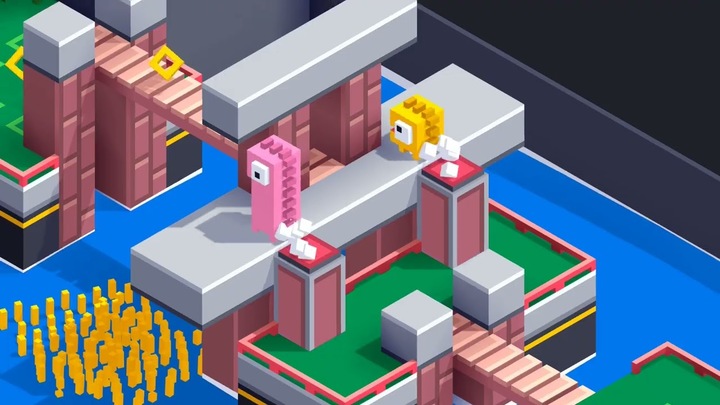
Dino Bros may appear on the surface to be a simplistic puzzle platformer designed for brief moments of mobile entertainment, but beneath its charming pixelated aesthetic lies a rigorous examination of human cognitive processing. The game tasks players with guiding two distinct dinosaur characters through a grid-based environment to collect coins and reach an exit, but it employs a critical twist: a single directional input moves both characters simultaneously. This mechanic immediately strips away the traditional comfort of singular avatar control, forcing the player to grapple with dual spatial awareness. By demanding that the brain track two independent physical bodies navigating distinct topographical challenges, the game elevates itself from a mere distraction into a profound exercise in spatial reasoning, working memory, and neurological adaptation.
The Genesis of Simultaneous Movement Mechanics
The foundation of Dino Bros rests entirely on the cognitive shock introduced by its core mechanic of one input resulting in dual output. When a player presses a directional button, both the Pinky and Yello dinosaurs move in that exact direction, provided their respective paths are clear of impassable boundaries. This immediate coupling of avatars creates a unique puzzle environment where every single spatial decision carries twice the consequence and requires twice the calculation. The player must project the trajectory of the first dinosaur while simultaneously predicting the final resting state of the second, a mental task that fundamentally disrupts the muscle memory built over years of playing standard single-character platformers.
This dramatic divergence from traditional game design serves as the absolute bedrock for the game's escalating mechanical complexity. In a standard linear puzzle game, an obstacle is merely a barrier for the avatar to overcome; in Dino Bros, an obstacle for one character might be an absolutely necessary tool for the survival of the other. The initial cognitive load presented to the player is deceptively heavy, as the human brain naturally attempts to focus on one single moving character at a time, leading to inevitable mistakes where the unmonitored dinosaur carelessly falls into a water hazard or misses a crucial moving platform. The game essentially demands that players quickly develop a highly specialized peripheral puzzle-solving vision.
Early Level Simplification
Despite the inherent difficulty and shock of the simultaneous movement mechanic, the early stages of the game are meticulously designed to trick the player into a comforting false sense of security. The first few levels present straightforward, unencumbered paths that require minimal divergent or complex mathematical thinking. This initial simplicity is strategically crucial; it allows the player to fully internalize the unbending rule that both characters share a single neurological and mechanical link before the game begins to aggressively and relentlessly test the limits of that very link.
Symmetrical Illusions in Early Stages
To ease the player into the jarring reality of dual character control, the developers heavily rely on strict structural symmetry in the introductory architectural layouts. When both dinosaurs start in mirrored positions and face identically mirrored obstacles, the overwhelming cognitive load is significantly and intentionally reduced. The brain effortlessly processes this visual symmetry, allowing the player to input movement commands with the absolute confidence that whatever action occurs on the left side of the visual space will perfectly and predictably mirror the right side. This clever design choice provides a comforting, highly predictable environment where the core physics and mechanics can be learned without inducing overwhelming player frustration.
Psychological Comfort Zones
However, this comforting structural symmetry is a meticulously calculated illusion, serving merely as a temporary educational scaffold that is meant to be violently dismantled. Because human spatial reasoning naturally and strongly favors symmetrical patterns, players quickly fall into a hypnotic rhythm, viewing the two distinct dinosaurs as a single, wide geometric entity moving through a perfectly uniform space. The game masterfully exploits this psychological comfort zone to quietly establish the immovable baseline rules of momentum, gravity, and grid-based movement before unleashing the chaotic, asymmetric elements that define the true Dino Bros gameplay experience.
The Breakdown of Symmetry
The incredibly subtle breakdown of this mirror-image symmetry acts as the primary and most effective pacing tool of the entire early game experience. A solid brick wall might be placed just one tile closer on the right side of the screen, or a crucial collectible coin might require a slight, uneven detour on the left side. These incredibly minute architectural alterations force the player to aggressively snap out of their symmetrical trance and begin treating the two halves of the screen as distinct mathematical problems that must somehow be solved with a single, unified directional equation.
The Introduction of Asymmetrical Obstacles
The true, unbridled genius of Dino Bros finally reveals itself when the game forcefully abandons all pretenses of symmetry, introducing highly asymmetrical obstacles that require the advanced technique of environmental anchoring. Anchoring occurs when the player strategically and intentionally drives one dinosaur into a solid wall, holding it completely in place while the other dinosaur continues to move freely through the environment. This counter-intuitive technique is the absolute only way to successfully desynchronize their relative grid positions, allowing the two avatars to navigate entirely different, highly specialized architectural challenges. The cognitive dissonance experienced during this sudden mechanical shift is profound; the player must consciously learn to use what is normally considered a failure state (hitting a wall) as a primary strategic tool.
This mechanical shift completely transforms the game from a test of basic thumb coordination into an incredibly complex, multi-layered sliding puzzle. The player must constantly and obsessively scan the entire environment for natural architectural backstops, calculating exactly which wall can serve as a safe anchor and for exactly how many grid steps. It requires a massive mental shift from seeing environmental obstacles as purely negative, restrictive elements to viewing them as essential, utilitarian features that enable progress. A wall is no longer just a stubborn barrier; it is a vital temporary parking brake for one avatar while the other is free to complete a dangerous sub-task.
The psychological and mental impact of this asymmetrical design philosophy cannot be overstated in the realm of puzzle games. It brutally forces the player to maintain two entirely separate, highly detailed mental maps of the level, constantly switching their visual and mental focus between the two dinosaurs to ensure that a necessary movement for one does not lead to the immediate, catastrophic doom of the other. The immense satisfaction derived from successfully repositioning the duo through a series of clever, calculated anchoring maneuvers is a powerful testament to the brain's remarkable ability to adapt to severe artificial spatial constraints.
Temporal Desynchronization and Momentum
As the spatial puzzles become significantly more intricate, Dino Bros suddenly introduces ruthless temporal variables that completely shatter the peaceful, static nature of the early grid-based levels. The implementation of unstable falling platforms and aggressively timed, periodically activating spikes adds a terrifying ticking clock to an already heavy and exhausting cognitive load. Previously, players could comfortably stare at an asymmetrical layout indefinitely, mentally tracing various paths and outcomes before fully committing to a physical move. With the sudden introduction of these time-sensitive elements, the luxurious comfort of static, patient contemplation is violently and permanently ripped away.
The Urgency of Falling Platforms
Falling platforms, which physically drop away into the abyss after a specific number of directional moves, forcibly impose a rigorous, unforgiving economy of motion upon the player. Players can no longer rely on inefficient, repetitive trial-and-error anchoring techniques to slowly inch their way to the solution; every single physical step must be perfectly and ruthlessly calculated to ensure neither dinosaur is left tragically stranded. This aggressive temporal desynchronization means that while the characters are still forced to move simultaneously in physical space, their respective survival windows might be operating on entirely different, conflicting timelines. One dinosaur might be safely resting on unmoving solid ground while the other is frantically navigating a rapidly crumbling bridge, demanding that the player prioritize the immediate, panicked survival of one without ever forgetting the long-term positional needs of the other.
The Unforgiving Rhythm of Spikes
The periodically activating floor spikes further complicate this desperate momentum by strictly dictating the exact rhythm and tempo of the player's physical inputs. The spikes effectively turn the entire game space into a deadly metronome, where a fraction of a second of hesitation is mathematically just as deadly as pressing the completely wrong directional input. The player must perfectly synchronize their complex spatial puzzle-solving methodologies with an external, unyielding temporal rhythm, violently marrying cold logic with frantic reflex in a way that aggressively and repeatedly tests the absolute limits of human working memory.
The Cognitive Toll of Split Attention
Navigating the treacherous mid-to-late stages of Dino Bros requires a level of intensely split attention that borders on the neurologically unnatural, providing a genuinely fascinating and observable case study in cognitive psychology. The human brain is inherently and evolutionarily wired for singular, highly focused attention on one specific task or threat. When forcefully asked to visually and mentally track two disparate focal points simultaneously, especially when both are constantly subjected to entirely different environmental pressures and physical threats, the brain predictably experiences a phenomenon scientifically known as cognitive overload. The player is essentially asked by the game to perform a continuous, high-stakes neurological juggling act with their own visual cortex.
To somehow cope with this immense psychological toll, dedicated players unconsciously develop a frantic coping mechanism known in cognitive science as rapid attentional shifting. Instead of genuinely and truly watching both dinosaur avatars at exactly the same simultaneous moment, the human brain rapidly flickers its localized focus back and forth between the two digital bodies at incredible, lightning-fast speeds. This rapid shifting is neurologically exhausting and remains highly susceptible to catastrophic error, particularly when a sudden, unexpected hazard demands immediate, localized attention. When the player frantically hyper-focuses on saving the Pinky dinosaur from an activating spike, they almost inevitably and entirely lose track of Yello, resulting in a frustrating but mathematically entirely predictable failure.
This exact psychological friction, this uncomfortable neurological stretching, is exactly where the game finds its most profound and rewarding moments of player engagement. The intense, unblinking focus required to somehow overcome this severe cognitive bottleneck eventually induces a powerful psychological state of flow, where the distractions of the outside world entirely fade away, and the absolute only reality is the digital grid, the spatial geometry, and the perfectly synchronized dance of the two avatars. The game does not merely challenge the physical dexterity of the thumbs; it actively and aggressively rewires the player's internal spatial processing pathways.
Environmental Hazards as Pacing Mechanisms
In the brilliant architectural design of Dino Bros, environmental hazards like deep, impassable water and deadly spike traps function far beyond their obvious, punishing role as simple fail states; they serve as incredibly sophisticated and invisible pacing mechanisms. In a puzzle game with absolutely no traditional roaming enemies or climactic boss fights, the static environment itself aggressively becomes the primary and relentless antagonist. Uncrossable water tiles strictly dictate the absolute, unyielding boundaries of the playable geometric space, harshly shaping the labyrinth and violently forcing the player into tight, claustrophobic corridors where every single movement must be heavily deliberate, slow, and mathematically precise.
These severe hazards actively enforce a strict, punishing trial-and-error learning loop upon the player. Because the negative consequences of a wrong spatial move are immediate, brutal, and completely binary, players very quickly learn to read the complex geometry of the level like a fluent secondary language. A seemingly impossible, massive gap over a deadly water hazard immediately and silently signals to the observant player that a complex anchoring maneuver is absolutely required somewhere else on the grid board. The hazards gently but firmly guide the player's deductive reasoning, quietly eliminating physically impossible paths and subtly pointing the way toward the one intended mathematical solution through the brutal, unyielding process of geometric elimination.
Furthermore, the exact placement of these deadly hazards is meticulously and cruelly designed to constantly break the player's easily established, comfortable rhythms. Just as a player finally becomes comfortable rapidly and mindlessly swiping through a familiar sequence of wall anchors, a perfectly, maliciously placed spike trap will suddenly force them to violently halt, completely reassess their forward momentum, and patiently wait for the appropriate, safe temporal window. This constant, demanding shifting of mental gears, from rapid physical execution to incredibly patient observation, prevents the core gameplay loop from ever becoming rote and maintains an exceptionally high level of mental engagement from the very first level to the absolute last.
The Paradigm Shift of Button and Gate Logic
The mid-game introduction of physical floor buttons that permanently or temporarily alter the environment fundamentally and permanently shifts the gameplay paradigm of Dino Bros from a purely spatial maneuvering puzzle to a highly sequence-based, logical conundrum. When one specific dinosaur is suddenly required to stand on a colored button to lower a solid gate or miraculously raise a floating platform for the other dinosaur, the core simultaneous movement mechanic is temporarily and jarringly subjugated to a strictly sequential, phase-based dependency. The two digital avatars are suddenly no longer just moving together through space; they are actively and cooperatively working together to manipulate the very physics of the game world.
This complex mechanic seamlessly introduces the strategic concept of the sacrificial or stationary pawn. Very often, one of the dinosaurs must painstakingly navigate an incredibly treacherous path simply to reach an isolated button, permanently locking themselves into a tiny, restricted geographic area so that their partner can safely traverse the newly opened path to collect necessary coins or reach a final exit key. The player must forcibly learn to view the dinosaurs not as fully equal entities with identical movement goals, but as highly specialized, individual tools with entirely distinct, phase-based operational objectives. This requires a terrifying level of long-term forward-planning that extends dozens of steps beyond the immediate, visible spatial obstacles.
Sequential Dependency Strategies
The raw logical processing power required to successfully parse these complex gate puzzles very often involves the mental strategy of working completely backward from the intended solution. The player must visually identify the final exit point, carefully determine exactly which colored gates block that specific point, trace those individual gates all the way back to their respective, hidden buttons, and then finally map out the incredibly intricate choreography required to position the dinosaurs correctly without accidentally trapping either one. This exhausting, multi-layered problem-solving fundamentally elevates the game from a reactive, fast-paced arcade experience to a slow, cerebral, chess-like planning exercise.
Spatial Entanglement in Advanced Levels
As exhausted players finally progress into the incredibly demanding advanced stages of Dino Bros, the sophisticated level design violently introduces the concept of spatial entanglement, where the physical paths of the two dinosaurs constantly cross, tightly overlap, or confusingly intertwine. Early tutorial levels politely keep the avatars strictly and safely separated in their own distinct visual zones, but the later, brutal puzzles force them to somehow navigate the exact same tight corridors or completely swap physical sides of the geographic map. This massive visual and spatial entanglement creates immense, overwhelming cognitive confusion, as the previously clear mental division between the left-side puzzle and the right-side puzzle completely and utterly disintegrates.
When the two digital avatars are forced into incredibly close physical proximity, the previously reliable anchoring technique suddenly becomes incredibly perilous and fraught with new danger. Using a solid wall to safely stop one dinosaur might inadvertently and disastrously block the only escape path of the other, instantly creating a fatal gridlock scenario where neither character can physically move in any direction. The panicked player must now manage not only the spatial relationship between the avatars and the static environment but also the dynamic, constantly shifting spatial relationship between the avatars themselves. They tragically become moving, unpredictable obstacles in each other's paths.
This severe entanglement demands a highly refined, almost clairvoyant mental map of the grid. The player must mentally visualize the game board not exactly as it currently is, but exactly as it mathematically will be three or four distinct moves in the future. The demanding cognitive ability to completely abstract the physical positions of the dinosaurs and accurately calculate their trajectories through tightly overlapping, shared spaces is the absolute ultimate test of the spatial reasoning skills the game has been quietly and ruthlessly teaching since the very first introductory level. It is a brilliant, chaotic, and exhausting culmination of the entire dual-control premise.
Verticality and the Stacking Mechanic
Perhaps the most ingenious and mind-bending subversion of the game's own established physical rules occurs with the late-game revelation of verticality and the avatar stacking mechanic. For much of the initial gameplay experience, players operate under the absolute, unquestioned assumption that the two dinosaurs are strictly and permanently bound to the flat 2D plane of the grid, moving only horizontally and vertically across the geometric map. However, the sudden, shocking discovery that Pinky can actually be physically stacked directly on top of Yello using specific environmental staircases permanently transforms the entire nature of the spatial puzzle.
This mind-blowing mechanic forces a radical, immediate reassessment of the game's entire geometric reality. Suddenly, massive obstacles that previously appeared mathematically insurmountable can be easily bypassed by physically combining the two separate avatars into a single, towering, two-story entity. This pseudo-3D logical problem requires the player to completely re-evaluate the environment, viewing it not just as a flat, unyielding floor plan, but as a complex space with tangible volume, elevation, and vertical opportunity. The sudden realization that the avatars can interact with each other physically, rather than just moving in tandem, shatters all previous assumptions and opens up a terrifying new realm of complex puzzle possibilities.
The absolute brilliance of the physical stacking mechanic lies entirely in its quiet subtlety. It is very often hidden in plain sight, remaining a latent, unused capability that is only absolutely required when the traditional 2D logic completely and utterly fails the player. When an exhausted player finally and miraculously realizes that the only possible mathematical solution involves carefully maneuvering one dinosaur directly onto the head of the other to desperately reach a high, floating key, the subsequent feeling of intellectual epiphany is genuinely unmatched in the genre. It is a perfect, shining example of a video game organically teaching a highly complex, game-changing concept without ever utilizing a single word of patronizing tutorial text.
The Climax of Reflex and Logic Integration
The incredibly brutal final stretch of Dino Bros serves as a grueling, but ultimately triumphant climax that aggressively and unapologetically integrates every single mechanic introduced over the entire course of the game. These final, punishing levels require the player to simultaneously and flawlessly manage asymmetrical environmental anchoring, rapidly falling platforms, aggressively timed spikes, sequential button logic, and vertical avatar stacking. The extreme cognitive demands reach an absolute crescendo, demanding a perfect, unyielding synthesis of pure, twitch-based reflex and deep, multi-layered logical puzzle planning.
In these ultimate, unforgiving challenges, there is absolutely zero margin for human error. A single, slightly miscalculated geometric step, a tiny fraction of a second of hesitation on a deadly spike trap, or a fundamental, tragic misunderstanding of the complex button sequencing results in immediate, frustrating failure. The exhausted player is forcefully pushed into a highly elevated state of total, unblinking concentration, where the rapid attentional shifting painstakingly developed earlier in the game must operate at absolute peak neurological efficiency. The brain must perfectly process the temporal rhythm of the hazards while simultaneously and flawlessly calculating the spatial geometry of the overlapping, entangled paths.
Core Competencies Tested
To finally conquer the excruciating final stages and complete the game, players must flawlessly demonstrate total mastery over several specific core competencies:
- Flawless execution of asymmetric environmental anchoring under extreme temporal duress.
- Perfect physical synchronization with moving hazards and rapidly crumbling floor tiles.
- Advanced, multi-step forward-planning for deeply sequential gate and button logic.
- Three-dimensional spatial reasoning actively utilizing the vertical avatar stacking mechanic.
Achieving final victory in these incredibly demanding final levels provides a profound, lasting sense of genuine intellectual mastery. The dedicated player has not merely beaten a simple puzzle game; they have successfully and measurably trained their own brain to temporarily overcome its natural biological limitations regarding split attention and dual spatial processing. Dino Bros stands as a brilliant, shining testament to the absolute power of minimalist game design, definitively proving that true depth and mechanical complexity do not arise from graphical fidelity or convoluted control schemes, but from the elegant, relentless exploration of a single, mind-bending mechanic.
Conclusion
Ultimately, Dino Bros entirely transcends its initial identity as a simple mobile or browser diversion to become a deeply fascinating interactive experiment in human cognition and spatial reasoning. By taking the universally familiar mechanics of the traditional puzzle platformer and aggressively applying a ruthless, unyielding dual-control constraint, the game systematically forces players to literally rewire their internal approach to spatial mathematics, working memory management, and temporal hazard synchronization. The long, difficult journey from the comforting, mirror-image symmetry of the opening tutorial levels to the chaotic, heavily entangled, and hyper-demanding architectural nightmares of the grand finale is an absolute masterclass in progressive difficulty and invisible mechanical pacing. Every single water hazard, every colored button, and every seemingly insurmountable brick wall is carefully and deliberately placed to strictly teach the human brain a completely new way of perceiving and manipulating the digital space. It is an experience that is effortlessly easy to understand within seconds, but excruciatingly difficult to truly master over hours, leaving a permanent, lasting impact on exactly how players perceive digital movement, logical sequencing, and the very real limits of their own cognitive attention spans.